


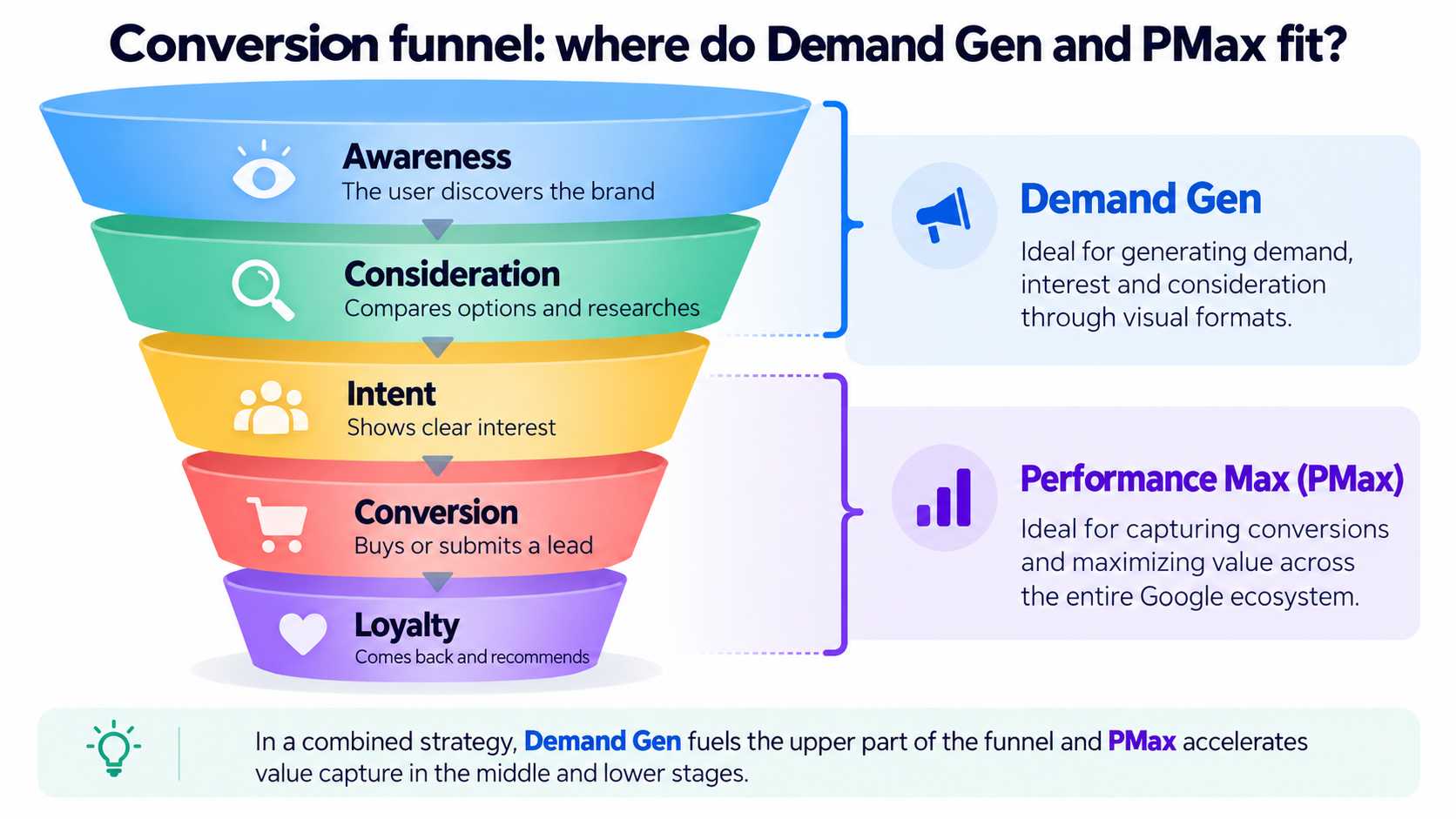
Although Demand Gen and Performance Max both leverage Google Ads machine learning, they are designed with distinct centers of gravity within the conversion funnel. They are not entirely opposite campaigns: both can generate conversions. The main difference lies in how much control the advertiser retains over audiences, channels, and creatives versus how much is delegated to Google's automation.
Demand generation and consideration: dDemand Gen allows you to step in earlier, when the user is not yet actively searching for the product or service. Its role is especially relevant for generating consideration and sparking interest through formats similar to those used on social platforms. Demand Gen works especially well when we want to control who we target, in what type of visual environment, and with which creative asset.
Performance Max is designed to maximize conversions or conversion value by automatically capitalizing on all available Google inventory. Instead of managing Search, Shopping, YouTube, Display, Discover, Gmail, or Maps as separate campaigns, Google can automatically decide where to show each ad based on the likelihood of securing a conversion or driving value.
Recently, it has become possible to assign different values to each channel, though this feature is still in beta.
The difference between both campaign types begins right from their initial setup. Regarding bidding strategies:
This allows Demand Gen to be used both for conversion strategies and for traffic or consideration goals
Is primarily focused on conversions and value. It mainly offers:
Performance Max does not feature Maximize Clicks as a primary bidding strategy.
Provides greater granularity in certain settings. Languages and locations can be managed at the campaign level or, depending on the selected configuration, at the ad group level. This enables structures where different ad groups target distinct areas or audiences.
You can analyze your performance by location with Dolnai and get useful insights to improve the results.
Languages and locations are managed primarily at the campaign level. Therefore, all asset groups within that campaign share these broad geographic settings.
Connecting to Google Merchant Center is optional. When a feed is used, Demand Gen can feature products within its ads and display them inside visual formats. This allows for combining: images, video, carousels, and catalog products.
Pmax can run without Merchant Center. However, for an e-commerce store with a product catalog, the Merchant Center feed is a crucial piece. It allows Performance Max to use structured catalog data and access product-based inventory across the Google ecosystem.
Offers a significantly higher level of control. Targeting can be configured based on: desktop, mobile, tablet, and TV. On specific devices, criteria like operating system, device model, and network can also be applied. As a result, Demand Gen allows you to better tailor a creative or audience strategy according to the device being used.
Device control is much more limited. Google automatically decides where to allocate spend based on conversion probabilities. There is no comparable control to Demand Gen for structuring a campaign around specific devices.
Both campaign types can leverage strategies geared toward acquiring new customers.
Demand Gen offers a particularly useful environment for testing creative or audience changes, whereas PMax experiments are more geared toward evaluating the overall impact of automation and different campaign configurations.
Uses a traditional structure: Campaign → Ad Group → Ads
Ad groups allow you to organize: audiences, targeting, ads, and creatives. The advertiser builds relatively defined ads and controls which assets are part of them.
Uses a different structure: Campaign → Asset Group → Assets + audience signals + products
Asset groups contain: headlines, long headlines, descriptions, images, videos, logos, products, and audience signals. Google dynamically combines these elements to assemble various ad combinations.
This is one of the most critical distinctions between both campaigns. Demand Gen provides greater targeting control. Performance Max utilizes audience signals as guidance for the algorithm, but not as a hard limit.
Allows advertisers to explicitly define the audiences they want to target. Options include:
However, Demand Gen can also use Optimized Targeting. When enabled, Google may expand delivery beyond the initially selected audiences if it identifies additional users with a high likelihood of converting. Thus, while Demand Gen offers greater audience control, it does not always imply strictly capped targeting. Demand Gen features lookalike audiences created from the advertiser's own first-party data. Historically, these audiences were configured using specific similarity levels.
Relies mainly on Audience Signals. These signals help the algorithm understand what type of user might be relevant, but they do not act as a strict restriction. Google can expand broadly beyond these signals when it identifies conversion opportunities. It does not have a dedicated equivalent tool to manually create a Lookalike audience. Google handles this type of expansion automatically through its machine learning models and the audience signals provided by the advertiser.
Allows you to apply audience exclusions and other targeting controls. Since Demand Gen does not participate in the traditional Google Search network, negative keywords do not play the same role as they do in Search or PMax.
Initially, there was no control at all, but for quite some time now, you can add negatives at the account and campaign levels, as well as apply brand exclusions.
From Dolnai, you can add negative keywords directly from your report, choosing the match type and structure.
Offers superior channel and inventory controls compared to PMax. Additionally, some exclusions related to content, locations, or placements are managed through Content Suitability controls and account-level settings. Therefore, it should not be viewed as a system where any single placement can always be excluded directly from every ad group.
Also allows applying certain placement exclusions, primarily through account-level controls and settings. The advertiser has less ability to dictate exactly where each creative appears.
From Dolnai, you can apply placement exclusions directly from your report. We recommend excluding Apps, YT videos not targeting your intended audience, and inappropriate websites.
Uses defined formats: Single Image, Carousel, Video, and product ads. The advertiser enjoys much greater control over which assets form part of a creative. Furthermore, Demand Gen allows using Creative Preferences to direct specific videos to particular YouTube placements, such as: In-Stream, In-Feed, and Shorts.
This makes it possible to adapt each creative asset to the consumption context—for instance, Shorts require vertical videos.
The advertiser provides various assets: headlines, descriptions, images, videos, logos, and products. Google automatically generates multiple combinations. Individual control over which headline pairs with which image or video is, therefore, much lower.
In your Dolnai report, you can also analyze the asset types performing best so you can replicate them and spot success patterns.
This is one of the areas where Demand Gen has evolved the most in recent years.Demand Gen can currently appear on:
Demand Gen has thus evolved into a much broader visual advertising platform than the former combination of YouTube, Discover, and Gmail.In addition, Google is progressively integrating capabilities historically associated with Display campaigns into Demand Gen.
Performance Max can utilize:
Its key distinction is that it can utilize virtually all Google inventory within a single campaign. In Dolnai, you can analyze channel distribution in detail, both overall and specifically for ads with product listings.
Performance Max can participate directly in Google Search. When a product feed is present, it can also leverage product inventory and Shopping. In this sense, PMax can capture users with very high purchase intent. Additionally, it can utilize YouTube, Display, or Discover to find new conversion opportunities.
Demand GenDoes not participate in traditional Google Search. However, it can feature Merchant Center products within visual formats. Consequently, a user can discover a product on YouTube, Discover, or other environments without having performed a traditional search yet.
Performance Max can show ads on YouTube. However, the advertiser has little control over the format, placement, or how much budget goes toward this channel. Moreover, if the advertiser does not upload a video, Google can automatically generate video assets using other available assets.
Demand Gen allows for much greater control. You can choose to use specific formats, enabling you to build creative assets tailored to each context:
Shorts → vertical video (9:16).
In-Stream → horizontal video (16:9).
In-Feed → creative asset designed to drive clicks or voluntary video views.
Demand Gen offers a higher degree of control over which channels and creatives to deploy. PMax incorporates these same environments as part of its automated inventory network.

.svg)