

Google is moving Search toward a model where we give fewer explicit instructions and more signals to the algorithm. We introduced AI Max in 2025. It is an extra layer for Search campaigns that broadens the searches it can capture. It can also adapt ad copy and even select a different landing page depending on search intent. Therefore, it’s not enough to simply turn it on and wait for the benefits. Every detail must be looked after, because the more power we give to the algorithm, the better the starting setup needs to be.
Based on thousands of accounts analyzed and conclusions gathered from our clients, here are the keys to making AI Max actually work:
AI Max needs to know what "success" means for the account.If you are optimizing toward irrelevant, duplicate, or low-value conversions, the AI will do exactly what you are asking it to do: find more of them. This happens in a very similar way in Performance Max campaigns.
It’s not enough to just maximize conversions. You need to decide what you really want to optimize for:
→ CPA
→ ROAS
→ Conversion value
→ Qualified leads
→ Actual sales
If your campaign is new or your budget fails to capture a minimum of 30 conversions per month, it will be difficult for the algorithm to have enough data to optimize results. That’s why turning on AI Max for Search without this minimum volume can be a waste of resources and time. We know enabling AI Max is a default recommendation in Google Ads, but we must be responsible and mindful of what we accept as a guideline without critical judgment. Remember that Google looks for more conversions than those set as primary; these can be configured at the account level or specified in each campaign. If each conversion has a different value to you, make sure to indicate it and choose to maximize conversion value.
With Final URL Expansion, Google can choose another URL from your domain if it considers it a better answer to the search, pulling information from it to generate ad headlines.This means website architecture becomes part of your Google Ads strategy.
Good landing pages → better signals.
A website full of irrelevant, non-conversion-focused, or outdated URLs can leave us exposed.
Also review this part in your Performance Max campaigns—especially the automatically created assets generated by Google. You can check them in the Assets section of your Dolnai report to see how they performed.
If you turn on URL Expansion, carefully manage URL inclusions and exclusions. Remember that inclusions serve as signals or guidelines for Google, but they aren't the only URLs it will expand to. This makes URL exclusions essential.
Exclude any URL that isn't conversion-focused (blog, thank you page, support, out-of-stock products, etc.). This setting is applied at the ad group level, so precision is key. Looking at all of this, it's clear that AI Max is not just a "set it and forget it" tool. It requires analysis.
AI Max combines broad match with keywordless technology to discover additional queries.While this can uncover fantastic demand, it also means reviewing search terms becomes even more important. Automation does not eliminate the manager’s job. We encourage you to use the cloud word section in Dolnai to add negative keywords efficiently and easily.
Review them weekly to refine traffic quality. If you are new to Dolnai, select a longer time frame (e.g., one year) to clean up your traffic and improve your baseline. When adding negative keywords, base your decisions on data: what converts and what doesn't.
As we mentioned in our previous blog post about Google's 2026 recommendations, brand controls are the best way to safeguard our own brand and the brands we don't want to target. Exclude your brand from generic campaigns, and if URL Expansion is enabled, make sure to exclude competitor brands or specify in your text guidelines that you don't want to mention them. If your website mentions competitors (for comparison purposes, for instance), you risk the ad mentioning them too and getting penalized for policy violations, even if it was an oversight.
Instead of adding brand names as negative keywords, using exclusions is recommended, as they automatically account for variations and potential misspellings.
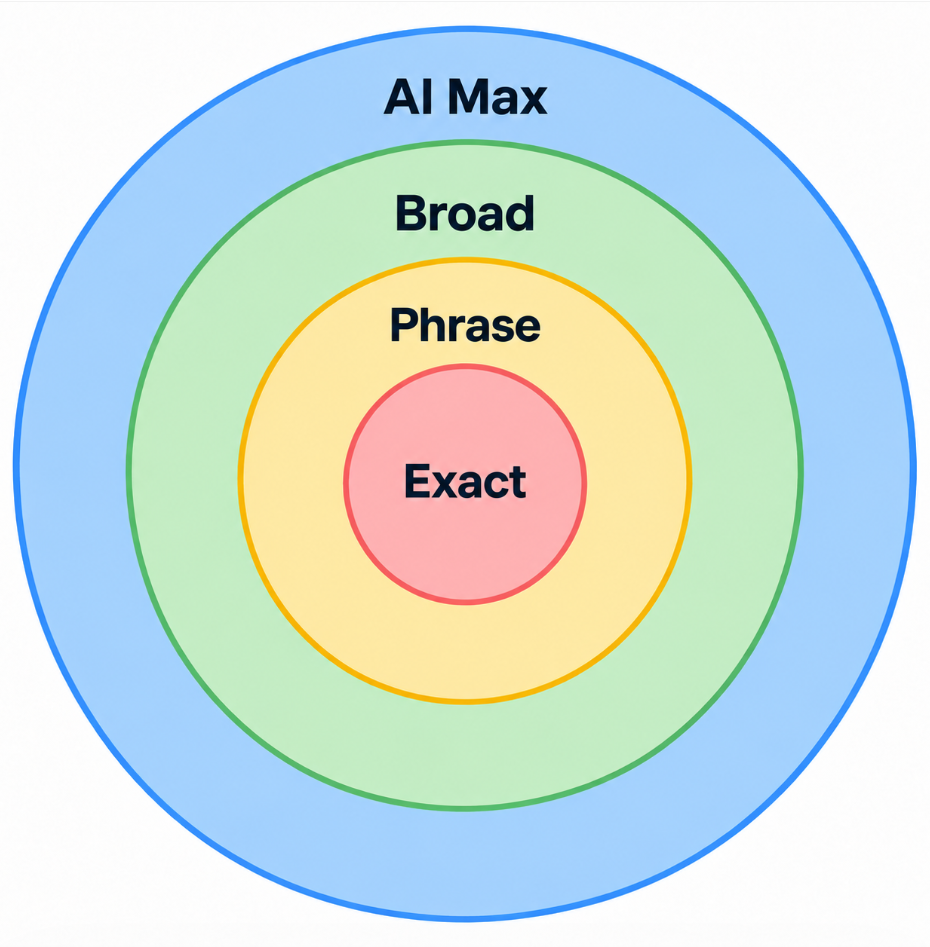
Google specifically points out that AI Max will not be effective if the campaign is budget-constrained. This might be the most overlooked point. AI Max works by seeking out terms that weren't captured before—it is an extension of broad match. Therefore, it's important that the majority of your conversions come from broad match keywords with a good quality score (at least 7).If you only use phrase and exact match, and your broad match keywords aren't performing well, turning on AI Max will be a mistake. This doesn't mean all your keywords must be broad match, but they should play the main role.
It means shifting from controlling every decision to controlling the system that makes those decisions.And that is the difference between:
❌ Turning AI Max on.and
✅ Making AI Max work well.
More automation should mean more control over signals, boundaries, and results—not less. If you have questions on how to activate your AI Max campaigns, reach out to your Dolnai Account Manager to guide you through the process.

.svg)