


Broad match can find demand that your keyword list would never predict. It can also spend money on searches that have nothing to do with your offer. Negative keywords for broad match are the control mechanism - not a reason to abandon broad match, but a way to make it accountable.
The mistake is treating negatives as a one-time cleanup task. Serious advertisers treat them as a decision system: identify irrelevant intent, measure the cost, choose the right exclusion level, and protect profitable discovery from overblocking. No guessing. No giant negative list copied from the internet. Just tighter control over where budget goes.
A negative broad match keyword blocks searches that contain all the words in your negative keyword, in any order. The query can contain additional words.
If you add free trial as a negative broad match keyword, Google Ads can exclude searches such as “free trial software,” “software trial free,” and “best free trial tools.” But it will not necessarily exclude close variants, misspellings, singulars, plurals, or related terms. Negative matching is less expansive than positive broad match behavior.
That distinction matters. Advertisers often assume a negative will catch every variation automatically. It will not. If “jobs” is a negative, searches for “job” or “career” may still appear. If those terms are also irrelevant, they need their own exclusions.
Negative phrase match gives you more control over word order. Negative exact match is the narrowest option, blocking only the precise search query without extra terms. Broad negatives are useful when the combination of terms always signals bad intent. Phrase and exact negatives are safer when context changes the meaning.
The goal is not to add the most negatives. The goal is to prevent clearly unprofitable traffic while leaving room for Google’s matching system to find qualified buyers.
The search terms report is where broad match earns its keep or exposes its waste. Review it on a recurring schedule based on spend and traffic volume. A large ecommerce account may need weekly checks. A lower-volume lead generation account may get more value from a monthly review over a longer date range.
Sort first by cost, then by conversions, conversion value, CPA, or return on ad spend. A query with five impressions and no conversion is not a priority. A query that spent $800 with zero qualified leads is.
Look for patterns, not isolated words. A single irrelevant query may deserve an exact negative. Repeated variants usually indicate a broader intent category that needs a phrase or broad negative.
For example, a company selling enterprise payroll software may find searches around “payroll jobs,” “payroll certification,” “payroll calculator,” and “free payroll templates.” Those are different problems. “Jobs” and “certification” are likely universal exclusions. “Calculator” could be a top-of-funnel opportunity if the business has a useful tool and a path to conversion. “Free” is not automatically bad either. It depends on the offer and the economics.
That is why blanket lists underperform. They confuse low conversion rate with irrelevant intent.
Broad match needs room to learn, especially when conversion tracking is reliable and bidding has enough quality data. If you exclude every unfamiliar query after one click, you are not controlling waste. You are cutting off discovery before it has a chance to prove itself.
Use three simple buckets:
Only the first bucket belongs in negatives immediately. The second bucket deserves observation and a clear spend threshold. The third bucket is an optimization problem, not a negative keyword problem.
A lead generation team, for instance, may see “how to fix a leaking roof” and decide it is irrelevant because it sells commercial roofing contracts, not homeowner repairs. But “commercial roof repair cost” may generate expensive clicks and few leads because the landing page pushes inspections rather than repair estimates. Blocking that query removes demand. Fixing the message may capture it.
Use negative broad match when a set of words together always represents unwanted intent. This works well for combinations like customer service, login portal, or free template when those searches cannot produce revenue for the account.
Use negative phrase match when word order carries meaning. A software advertiser might exclude “how to become” to avoid career-related searches while preserving queries that use the same words separately in another context.
Use negative exact match when a query is unprofitable but its component words could be valuable elsewhere. This is common with ambiguous terms, competitor queries, and product names that overlap with your own category.
Do not let match type become a theoretical debate. Ask one operational question: how much relevant traffic could this exclusion accidentally block? The more ambiguity in the query, the narrower the negative should be.
Where you add a negative is as important as the negative itself. Account-level exclusions are for universal waste: careers, support, login, scam-related terms, or geographic areas the business will never serve. Shared negative lists are useful for rules that should apply consistently across campaigns and accounts.
Campaign-level negatives are for intent separation. If a brand campaign should not show for generic research terms, or a high-intent campaign should not compete with a category campaign, campaign-level control keeps traffic organized without shutting down the whole account.
Ad group-level negatives can help in tightly structured search campaigns, but use them carefully. They can become difficult to audit and can hide overlap problems rather than solve them. Broad match campaigns built around themes usually benefit more from clear campaign intent and disciplined shared lists than from hundreds of micro-exclusions.
For agencies, governance matters even more. A negative added to solve one client’s problem should not quietly become a default rule for every account. The right list is based on the client’s offer, market, geography, and qualification criteria.
Negative keywords can lower wasted spend and also lower conversions if they are applied without context. The most common damage comes from excluding terms that appear in both weak and high-value searches.
Consider “cheap.” For a premium B2B service, it may attract poor-fit buyers. For an ecommerce retailer competing on price, it can be commercial gold. The same applies to “free,” “best,” “reviews,” “comparison,” “used,” and competitor names. Intent is not contained in one word.
Before adding a broad negative, inspect the queries it would affect. Check conversion quality, not just platform conversions. If your CRM shows that a term produces fewer leads but more sales-qualified opportunities, a Google Ads-only decision can be expensive.
Also review negative lists after major changes in products, promotions, locations, and strategy. A term that was irrelevant six months ago may become profitable when the offer changes. Old negatives are not harmless. They are hidden decisions that continue spending control on your behalf.
A practical routine is better than a heroic quarterly cleanup. Review high-cost non-converting queries, search terms with poor downstream lead quality, and new query themes every week or month. Document why each recurring negative exists and where it is applied.
Track the impact after changes. Did irrelevant spend fall? Did impression share, conversions, CPA, or conversion value shift? If performance drops after a large batch of negatives, do not assume the market changed. Audit the exclusions first.
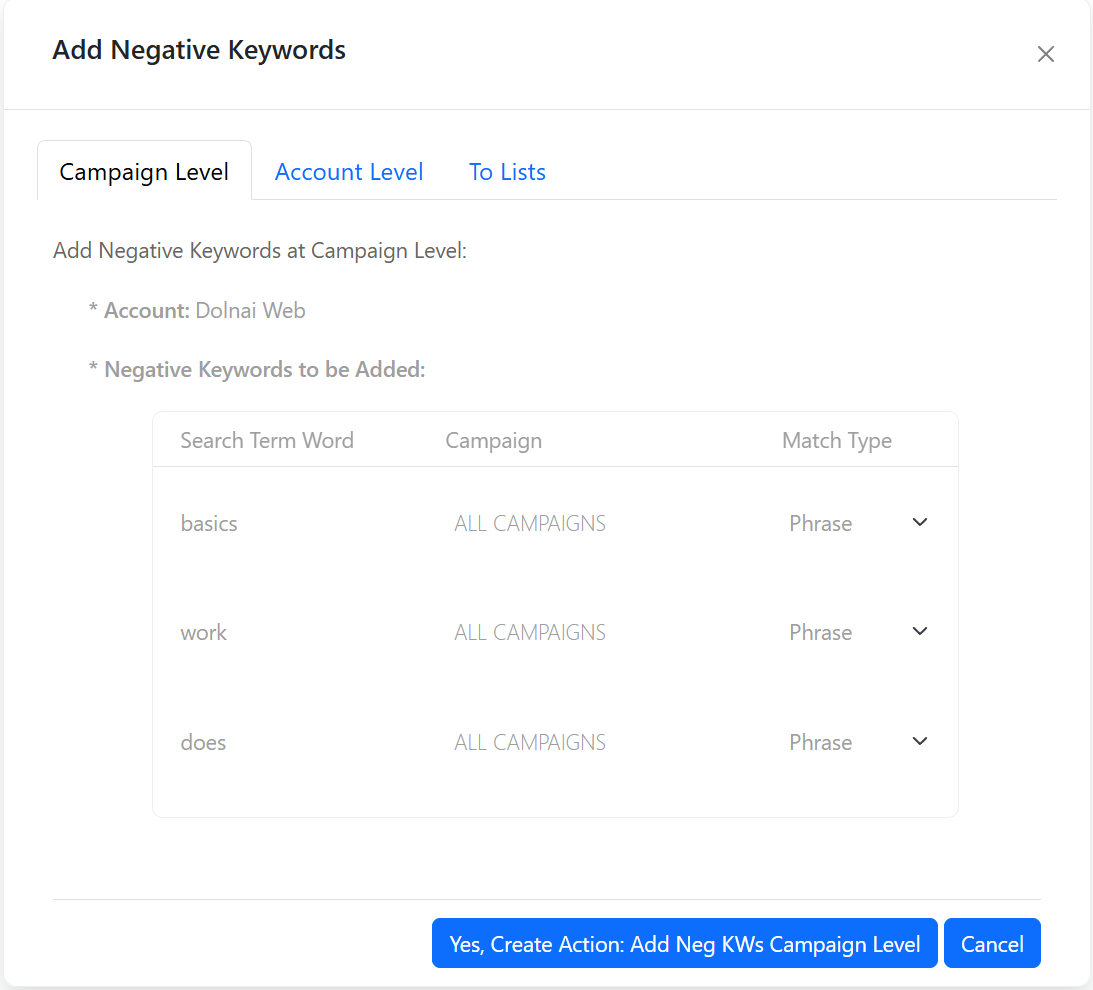
This is where independent account analysis earns its place. Platforms are good at serving ads. They are not always good at highlighting the quiet patterns draining budget across campaigns. Dolnai helps teams surface those patterns, prioritize the biggest leaks, and turn them into actions without taking control of the account. Use the N-Gram section in Dolnai to add negative keywords in bulk. Available in Search, Shopping, and Performance Max campaigns. You can analyze patterns, performance, and choose the match type and level for every negative keyword.
Broad match is not reckless by default. Unexamined broad match is. Keep the discovery engine running, but make every exclusion a deliberate business decision. Your negative list should not be a graveyard of random words. It should be a clear record of the demand your business has chosen not to pay for.

.svg)