

A 5/10 Quality Score is not a creative writing problem. It is usually evidence that your keyword, ad, landing page, or all three are failing to meet the searcher at the exact moment they are ready to act. If you need to improve Quality Score in Google Ads, stop making account-wide cosmetic changes. Find the queries consuming meaningful spend, diagnose the weak component, and fix the mismatch.
Quality Score does not pay your invoices. Profitable conversions do. But Quality Score affects the price and visibility you need to earn those conversions. Ignore it and you may pay more for the same click. Chase it blindly and you can waste time improving keywords that barely enter auctions. The job is to use it as a diagnostic signal, not a vanity metric.
Google Ads reports Quality Score from 1 to 10 at the keyword level. It is based on expected click-through rate, ad relevance, and landing page experience. These are estimates, not a complete explanation of every auction outcome. Your actual auction-time quality also reflects context such as the query, device, location, audience, and competition.
That distinction matters. A keyword can show a low visible Quality Score while still producing profitable leads in a valuable segment. Another can show an 8/10 score but spend heavily on weak queries and produce nothing useful. Treat the score as an invitation to investigate, then let conversion quality and cost decide the priority.
Start with keywords that have enough impressions and spend to matter. A 3/10 keyword with 12 impressions is not an emergency. A 4/10 non-brand keyword that has spent $4,000 this month with a rising CPA deserves attention now.
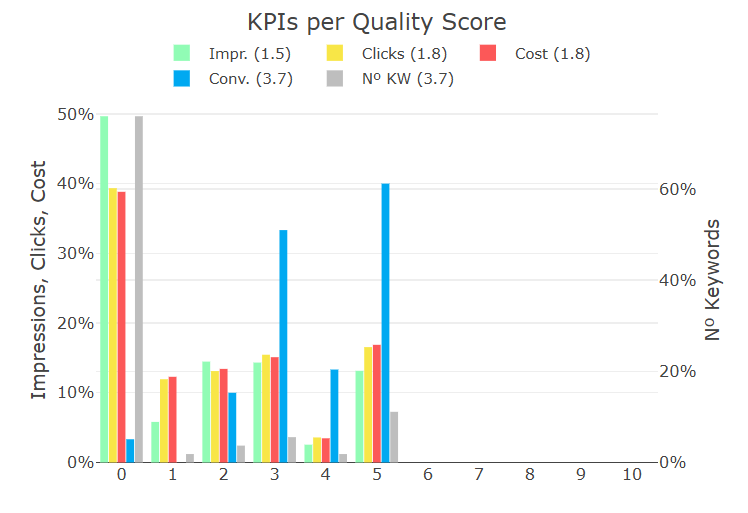
From its Keyword Library section, Dolnai analyzes your keyword KPIs so you can evaluate the number of competitors, impression density, and traffic for each keyword using expanded data. It classifies them into potential keywords to pause due to poor performance, and keywords to boost because they deliver above-average results compared to their ad group. Even if you consider a keyword vital to your account, the data doesn't lie. If it never converts and brings low-quality traffic, it is better to pause it and reallocate that budget to keywords that actually drive profit.
From Dolnai, you can analyze which keywords are underperforming compared to others in the same ad group and pause them because they are driving similar traffic.
- Expected CTR asks a simple question: compared with competing ads in similar auctions, how likely is your ad to earn the click? Below average often points to weak positioning, generic copy, an uncompetitive offer, or keywords that are too broad for the ad group.
- Ad relevance measures the connection between the keyword, the query intent, and the ad. When this rating is below average, your ad group may be mixing different needs. A user searching “emergency plumber near me” needs a different message from someone searching “water heater installation cost.” One generic ad cannot be highly relevant to both.
- Landing page experience is where many teams hide from the real work. A fast, mobile-friendly page is only the starting line. The page must continue the promise made by the query and ad, make the next action obvious, and provide enough proof for a skeptical buyer. Sending every paid click to a broad homepage is not a landing page strategy. It is a budget leak.
Most Quality Score problems begin before the ad is written. They begin when unrelated queries are forced into the same keyword and ad group.
Review search terms for your priority keywords. Look for different modifiers, use cases, product categories, locations, and stages of intent. If one keyword is matching research queries, price comparisons, support requests, and purchase-ready searches, no amount of headline testing will create clean relevance.
Use negative keywords to remove traffic you do not serve. Split genuinely different intent clusters into their own ad groups when each cluster has enough volume and requires a distinct message or landing page. Do not fragment campaigns simply to make the account look tidy. Excessive segmentation creates thin data, maintenance burden, and weaker testing. Split when the searcher needs a materially different answer.
Match type also deserves an honest review. Broad match can work when conversion tracking is trustworthy, bidding has sufficient data, and search term monitoring is active. It can also inflate irrelevant reach when those conditions are absent. The right question is not whether broad match is good or bad. It is whether your account can control and learn from it.
For each priority intent cluster, write ads around the buyer's immediate question. Put the core service, product, category, or outcome in prominent headlines where it is accurate and useful. Follow it with a concrete reason to choose you: pricing clarity, turnaround time, availability, inventory depth, expertise, guarantee, or proof.
Avoid the usual filler: “quality solutions,” “trusted partner,” and “industry-leading service.” These phrases say nothing a searcher can use to make a decision. They are also unlikely to beat a competitor who states exactly what they offer, where they offer it, and what happens next.
Responsive search ads need enough distinct assets to test, but variation is not the same as random word salad. Build headlines around a few clear themes: query alignment, value proposition, proof, and action. Use pinning sparingly when legal language, a brand requirement, or a critical message must appear in a fixed position. Pin everything and you reduce the system's room to learn.
Then judge the result with more than CTR. A higher CTR from vague curiosity can lower CPA only if those additional visitors convert. Compare conversion rate, CPA, and lead quality after a meaningful volume of traffic.
When landing page experience is below average, inspect the page as a paid visitor would. Does the headline mirror the intent behind the ad? Can users immediately understand the offer? Is the primary action visible on a phone without a scavenger hunt? Are forms, pricing, shipping terms, or qualifications creating friction that the ad failed to set up?
Message continuity is often the fastest win. An ad for “enterprise payroll software” should not land on a generic software directory. An ad for “same-day AC repair” should not lead with a corporate mission statement. Match the page title, headline, supporting copy, proof points, and call to action to the specific promise that earned the click.
Technical issues still matter. Slow mobile pages, intrusive pop-ups, broken forms, and unstable layouts damage both user experience and conversion rate. But do not confuse technical cleanup with relevance. A fast page that answers the wrong question is still the wrong page.
Quality Score can change slowly, and reported scores are not a clean before-and-after experiment. Track the business metrics alongside it: impression share, average CPC, CTR, conversion rate, CPA, conversion value, and qualified lead rate where available.
Document what changed and when. If you revised ads, added negatives, and replaced a landing page in the same week, you may improve performance but learn little about the cause. For high-volume areas, stage changes where possible. For smaller accounts, prioritize practical gains over laboratory-perfect testing, but keep a clear change log.
An independent diagnostic layer can help teams identify which low-score keywords are actually draining budget and whether the root cause is relevance, search terms, or landing-page mismatch. Dolnai is built for that kind of prioritization: no campaign takeover, no black-box promise, just actionable clarity on where an account is losing efficiency.
Review Quality Score trends on a regular cadence, but do not turn the review into a monthly ritual of rewriting every ad. Focus on meaningful spend, clear component weaknesses, and conversion impact. Preserve what is profitable. Fix what is provably misaligned. Challenge anything that looks good in Google Ads but fails in your CRM or revenue data.
The best Quality Score work is rarely dramatic. It is the repeated removal of friction between a real search, a credible ad, and a page that makes the next step easy. That is how lower CPCs become more than a dashboard improvement. They become room for more profitable growth.

.svg)