

Prompt Planner transforms market demand into three types of actionable intelligence that your team can use right away:
To do this, when requesting an analysis, Dolnai provides several fields to fill out. The more thorough you are when completing them, the higher the quality of the result will be, and the more valuable the information you obtain will be to apply later in your mission to understand the market, fill out your website's FAQs, or create new ads with creative angles that truly interest your audience.
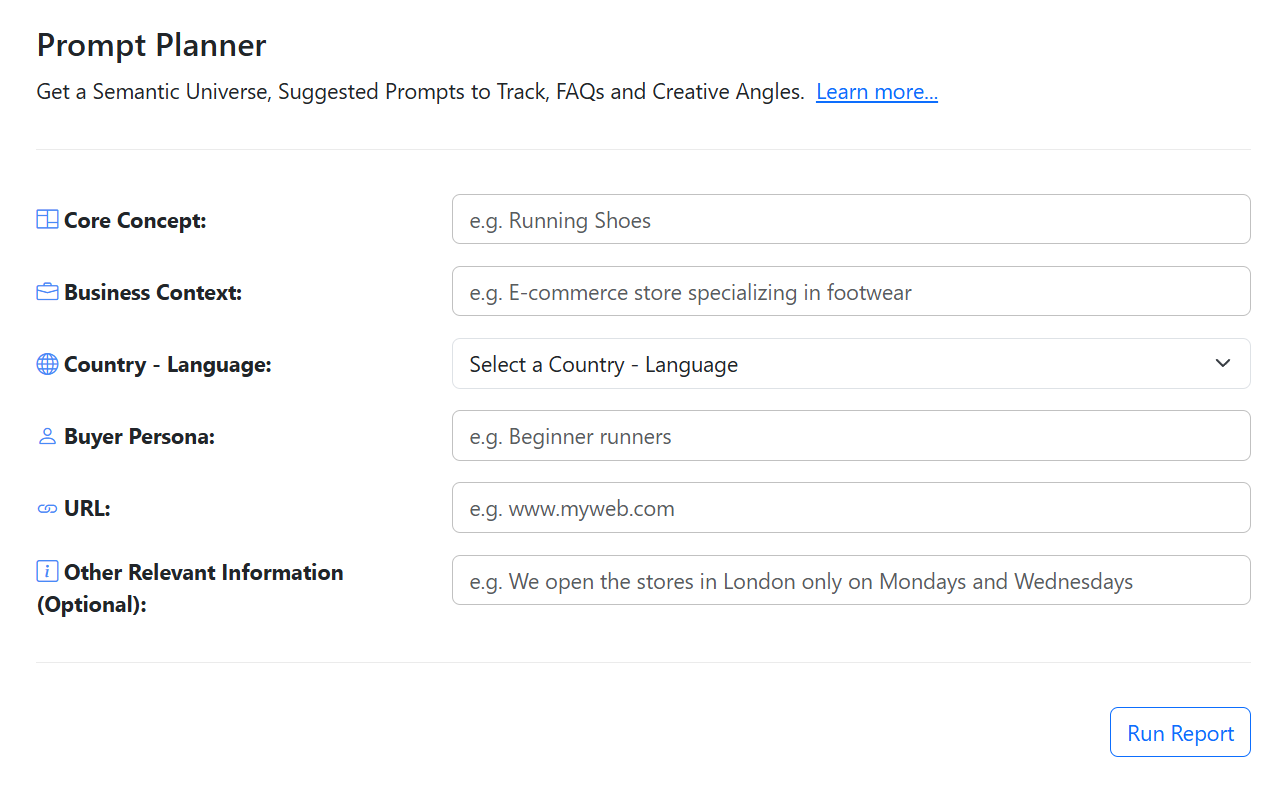
Main topic you want to research. It is very important to be specific so that the result addresses the exact focus you are interested in investigating.
Example: if we want to advertise and position a line of children's books about animals by habitat, it will be much better to fill in the key concept with "children's books about animals in nature" instead of "animal books" or "children's books". This avoids having part of the result focus on illustrated animal guides or how to care for pets.
Refers to the objective behind that research. If what we want is to sell books, that must be specified; another objective could be educational outreach or raising awareness among young children about animal care
Example: publisher launching a new line of children's books or driving sales of children's books.
Refers to the market we want to research. We might do research in Spanish for the UK market or for another country in the same language, such as Colombia, to better account for the competition. Language is very important, as the prompts, FAQs, and creative angles will be generated in the specified language.
Profile of the person the campaign and FAQs are aimed at; the more specific it is, the more tailored the result will be.In the case of the books mentioned, you would need to indicate whether they are parents, teachers, or (less common in this case) the children themselves, since each profile is interested in a different type of information. For teachers, for instance, it will focus more on how to introduce the books into the curriculum and what activities can be done based on them. Meanwhile, parents will mainly be concerned that their children are entertained and that the book format is safe.
The landing page where you have information about the product or service being researched. It provides additional context on the topic.
This field is optional, but you can add any other data you consider relevant to further refine the results.In the book example, you could mention that the animal illustrations in the books are very realistic with neutral colors, or that they are aimed at children aged between 3 and 6 years.