

Introducing Dolnai’s new Creative Intelligence Reports: a powerful new way to analyse thousands of images and ad copy assets in Performance Max and discover the ingredients behind more clicks, conversions, and sales.
Imagine you run an online pet store.
Your Google Ads campaigns feature hundreds of different images: dogs playing in the park, cats relaxing on sofas, bags of pet food against white backgrounds, colourful product photos, images featuring discounts, others with prominent call-to-action buttons...
And one day, you ask yourself a seemingly simple question:
What works better: a dog looking straight at the camera, a playful cat, or simply a great product photo?
And what about the background colour?
Does adding promotional text make a difference?
What if the animal appears alongside a person?
Do close-ups outperform lifestyle shots?
What about images featuring a call-to-action button?
We could keep asking questions for hours.
The interesting thing is that at least some of the answers are already hidden in your campaign data.
The problem is that, until now, finding those answers has been incredibly difficult.
And that's exactly what we're changing with Dolnai's latest capabilities.
At Dolnai, we've spent years developing technology to help agencies and advertisers understand what's really happening inside their Google Ads campaigns.
Much of that work has focused on opening Google's black boxes, particularly Performance Max.
Our reports help advertisers discover where their budgets are going, which products are selling, which are wasting money, how traffic is distributed across channels, and which advertising assets deliver the best results.
But there was one question we still couldn't answer satisfactorily.
We know which ads perform well. But do we really know WHY they perform well?
Because discovering that an image achieves a 7% CTR is one thing.
Understanding what makes that image more appealing than the others is something entirely different.
Is it the colour? The composition? The presence of people? The product itself? The expression on someone's face? The promotional offer displayed on the image?
And exactly the same applies to ad copy.
We know that a headline generates conversions, but what makes it effective? Is it talking about savings? Mentioning the price? Asking a question? Creating fear of missing out? Or building trust?
If we can answer those questions, we can move beyond optimising individual ads and start discovering the creative principles that work for each business.
And that's the leap we've just made.
We've just introduced a new generation of Dolnai reports that combine artificial intelligence and data analysis to break down Performance Max creatives into their fundamental characteristics.
The idea is simple to explain, even if the technology behind it is anything but.
Instead of treating an image or a headline as one indivisible piece, we identify the elements that make it up and connect them with its actual Google Ads performance data.
It's almost like taking an ad apart, examining its individual components, and discovering which ones appear most frequently in successful creatives.
And we're not talking about analysing ten or twenty ads.
We're talking about hundreds or thousands of advertising assets.
Without having to review them manually, one by one.
Let's see what this means in practice.
Until now, analysing large numbers of Performance Max images has largely been an exercise in patience.
You could review thumbnails, examine their metrics, sort assets by CTR or conversions, and try to identify visual patterns.
But when you're dealing with 500, 1,000, or 3,000 images, finding consistent relationships between their characteristics and results becomes practically impossible to do manually.
Now Dolnai can automatically analyse the visual characteristics of each asset.
And we're not just talking about recognising whether an image contains a dog, a car, or a person.
We're talking about identifying multiple creative dimensions:
Each image stops being just a JPG or PNG file.
It becomes a set of characteristics that we can measure and compare.
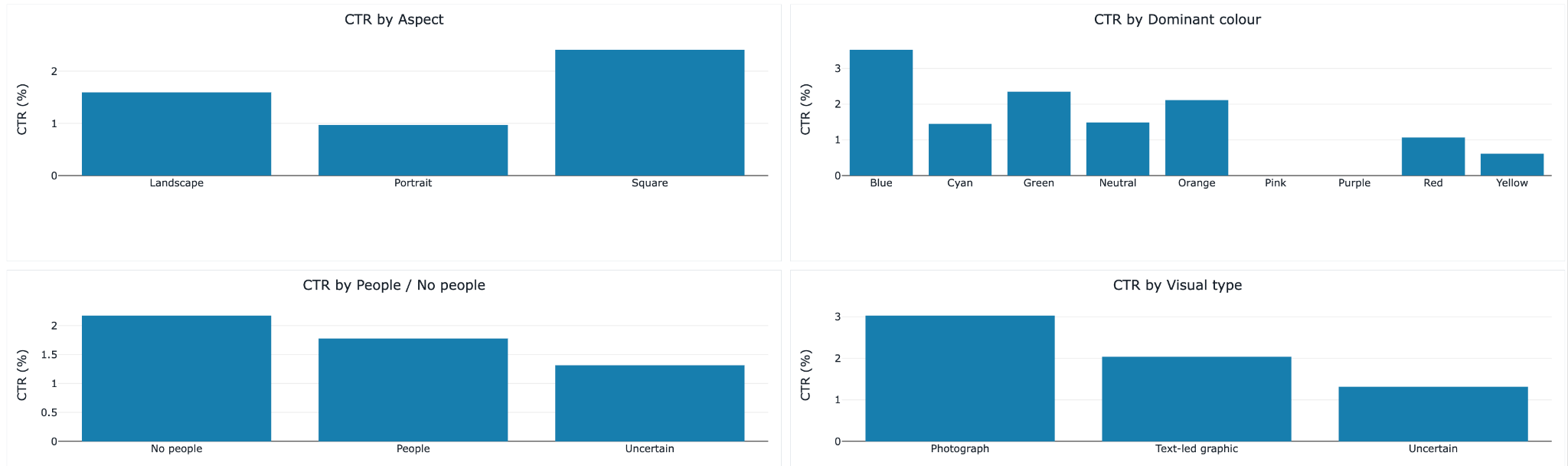
Suppose we analyse the images used in a pet retailer's Google Ads campaigns.
Our reports could help answer questions like these:
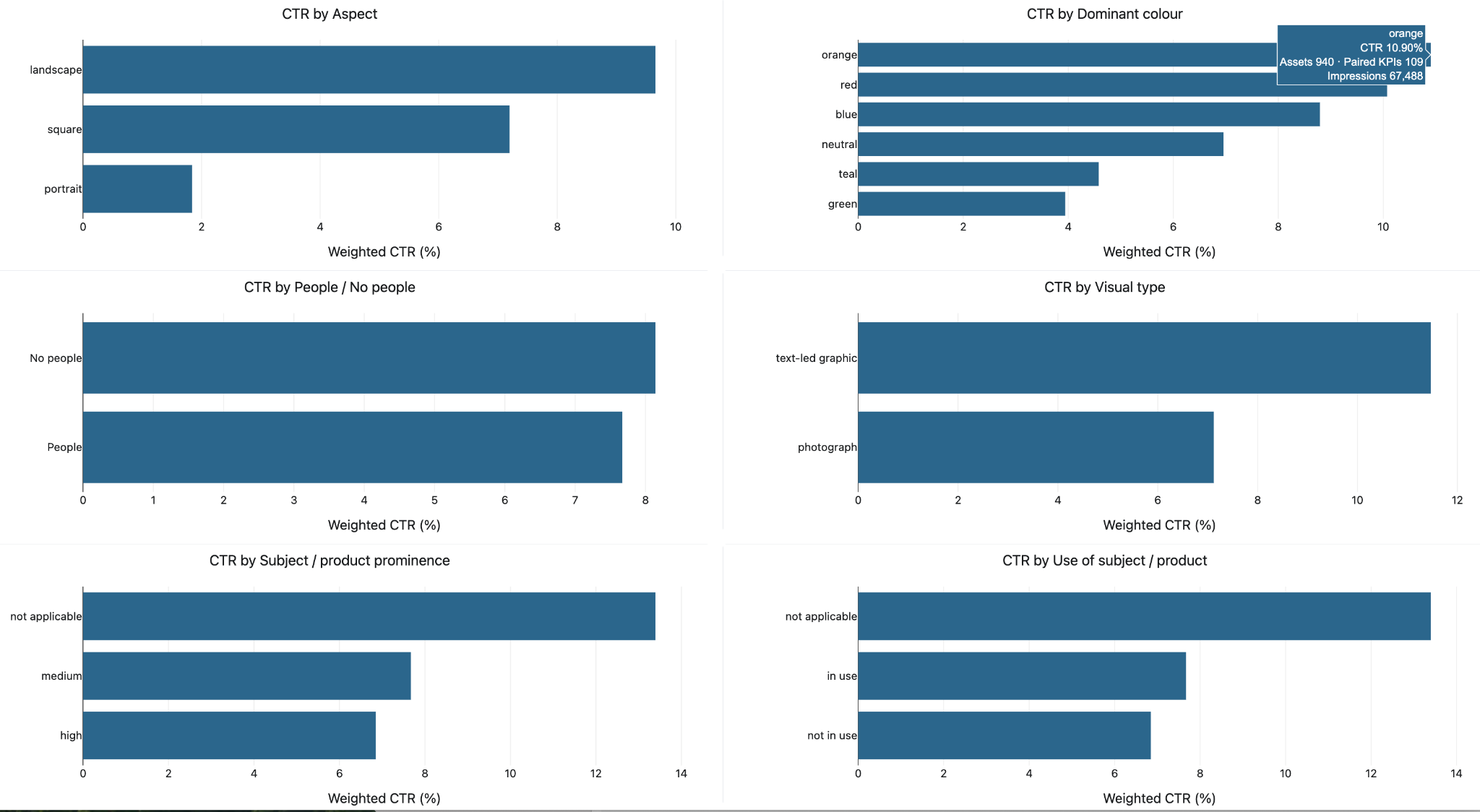
Do pictures of animals perform better than product-only images?
Perhaps images featuring pets achieve higher CTRs, while images where the product is clearly visible generate stronger conversion rates.
What happens when we add text to an image?
Promotional messages might attract more attention, while clean product photography without overlaid text could be more effective for certain product categories.
Which colours work best?
Maybe images with light backgrounds outperform those with darker ones. Or perhaps warm colours attract more clicks, while neutral tones work better in other categories.
Does including a person make a difference?
We could identify differences between images featuring animals alone, animals with people, or images showing only the product.
And what about format?
Do square images convert better than landscape images? Are close-ups more effective than lifestyle photography?
These are examples of questions we can now investigate systematically.
The answers depend on each advertiser's own data, not on universal aesthetic rules.
Imagine the analysis reveals that, within a particular product category, images combining light backgrounds, prominent products, and simple compositions consistently outperform comparable creatives.
That's valuable insight.
Because we can use it to make specific decisions:
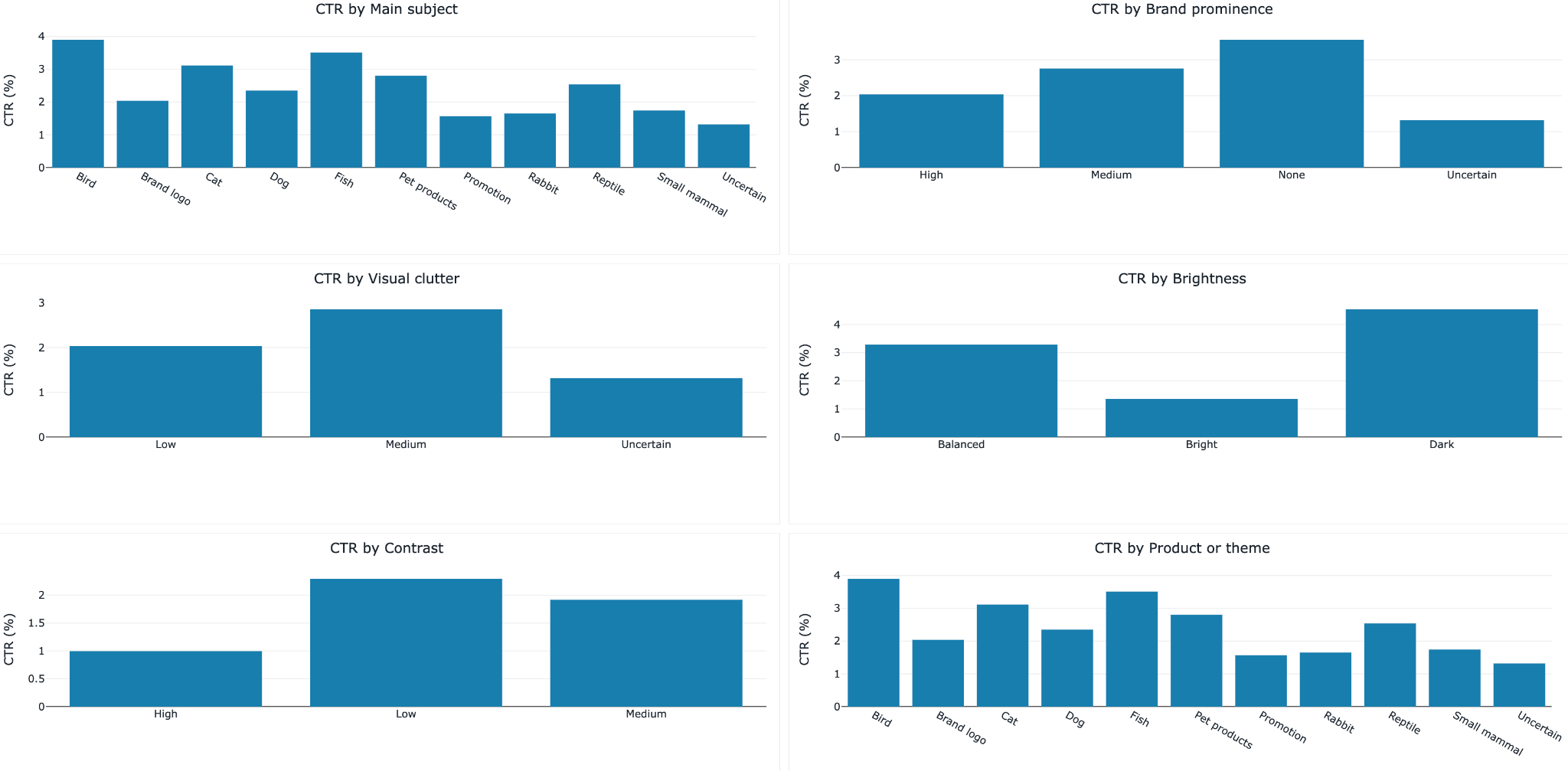
Create new images that reproduce those characteristics, review assets that move away from the winning pattern, and design smarter creative experiments.
And the best part is that we can discover combinations that would probably go unnoticed during a manual review.
We're not asking AI which image looks prettier. We're using AI to understand what each image contains, then comparing those characteristics with how real users respond.
That's a huge difference.
The second major development is just as exciting.
Because we all know that a great headline can dramatically change an ad's performance.
But what actually makes a headline great?
David Ogilvy, one of advertising's most influential figures, spent much of his career understanding which messages captured attention and persuaded consumers.
Today, we can explore many of those questions using quantitative data from our own advertising campaigns.
Think about an online store using headlines like these:
They're all advertising the same store.
But each headline uses a completely different selling argument.
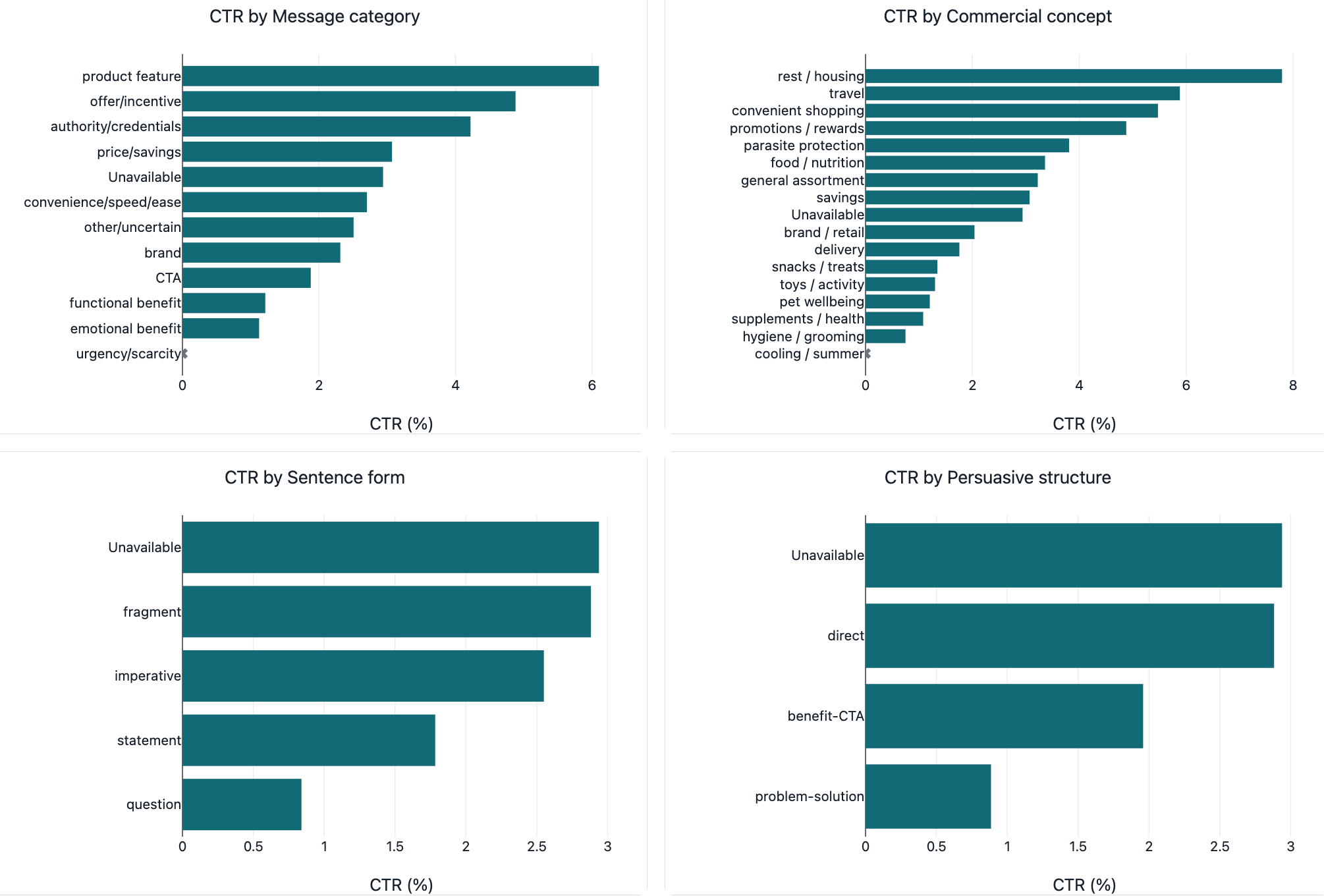
Some emphasise quality, others savings or convenience, others appeal to emotions, and others provide a direct incentive to buy.
What if we could analyse hundreds of headlines and discover which selling arguments work best?
That's exactly what Dolnai's new ad copy reports are designed to do.
Our technology analyses headlines and descriptions to identify three fundamental dimensions.
First: the commercial concept. What are we really selling?
I'm not talking about the physical product, but the argument used to persuade the customer.
It might be savings, speed, quality, exclusivity, security, convenience, trust, a promotional offer, or the solution to a specific problem.
We also identify brand messages, product features, functional benefits, emotional appeals, and calls to action.
Second: the persuasive structure. How is the message constructed?
Saying "Save on Your Car Insurance" is not the same as asking "Are You Paying Too Much for Car Insurance?"
And "24-Hour Delivery" is quite different from "Order Today, Get It Tomorrow".
We can analyse whether advertisers use questions, statements, commands, comparisons, contrasts, problem-solution structures, benefit-proof arguments, or messages that address customer objections.
Third: language attributes. How is the message expressed?
Here we examine details such as headline length, the use of numbers, percentages or monetary amounts, emotional intensity, the specificity of the benefit, and whether the message focuses on the customer or the product.
And then we connect all that information with each asset's performance.
Imagine your campaigns reveal that messages focusing on savings generate more conversions than those emphasising quality.
But when you dig deeper, you discover that savings headlines mentioning a specific amount achieve a better CPA than those using generic expressions.
And that direct promises outperform question-based headlines.
You've just identified an interesting creative combination:
Financial benefit + specific number + direct promise.
Now you can use that knowledge to develop new messages and test whether they improve results.
And you can investigate many other questions:
Do emotional messages outperform rational ones?
Is it more effective to talk about what customers will gain or what they might lose?
Do headlines featuring the brand name convert better than those emphasising a benefit?
Do shorter headlines outperform more descriptive ones?
Do direct calls to action work better than softer invitations?
The answer no longer depends solely on the creative team's opinion, the agency's intuition, or the marketing manager's preferences.
We now have a way to look for it in the data.
So far, we've talked about identifying colours, shapes, subjects, benefits, and persuasive structures.
But that alone wouldn't be enough.
A tool that simply classified images and ad copy might be interesting, but it wouldn't necessarily help you improve Google Ads performance.
The real value comes from connecting those creative characteristics with actual performance metrics.
That's why our reports incorporate indicators such as impressions, clicks, CTR, cost, conversions, and cost per conversion.
The goal is to distinguish between three very different situations.
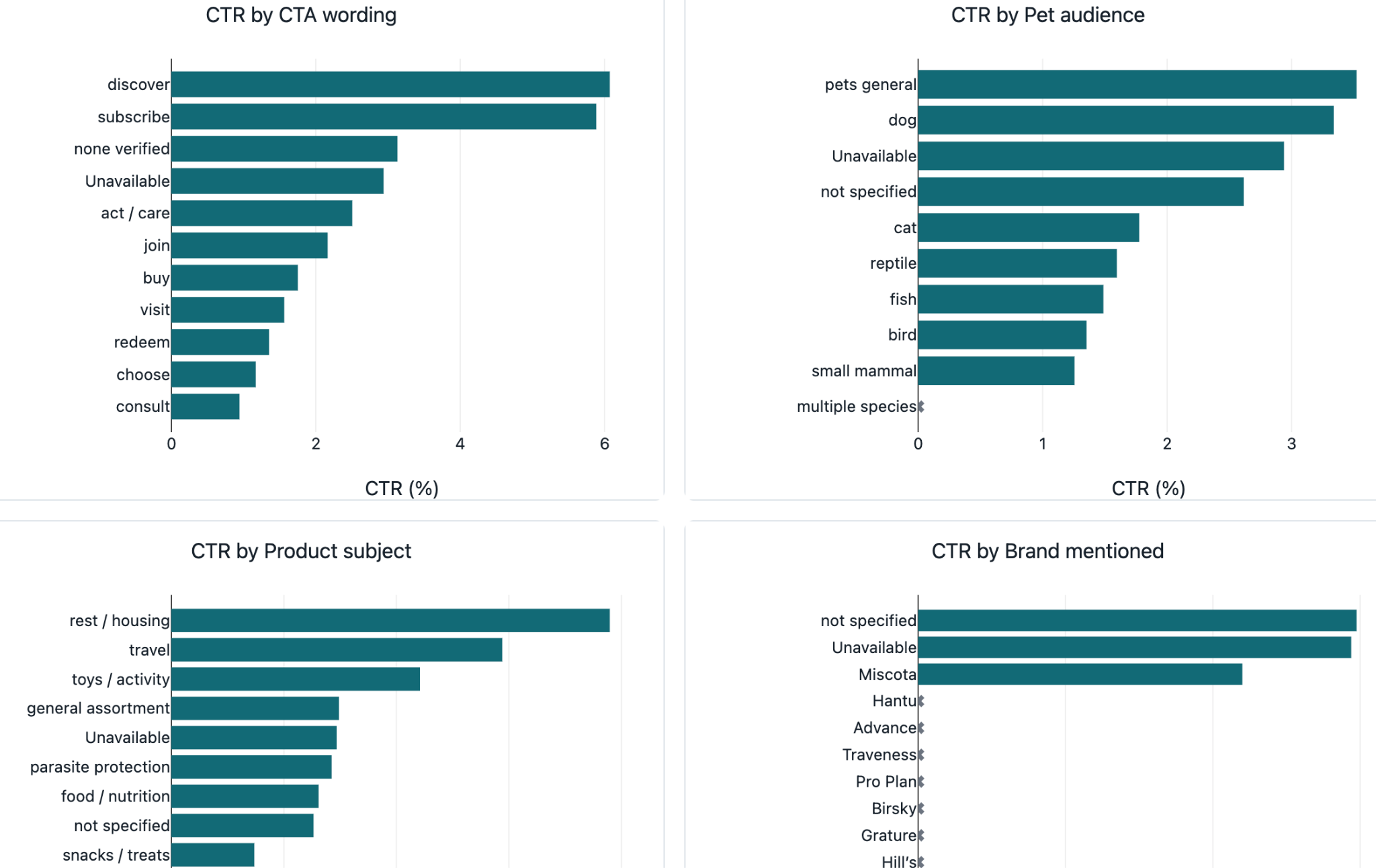
These are the assets that stand out because of their ability to generate clicks.
An eye-catching image might achieve an excellent CTR.
But that doesn't necessarily mean it's helping you sell more.
These are assets associated with stronger conversion results and better cost efficiency.
They might not be the most visually spectacular, but they attract traffic that's more likely to buy.
And for most advertisers, that's far more important than having a beautiful ad.
These are assets performing below comparable alternatives.
Perhaps they attract clicks but generate very few conversions.
Or perhaps they contain characteristics frequently found in the account's least effective messages and images.
We can now identify those patterns and use them to decide what should be reviewed, replaced, or tested.
There's an important issue here.
We can't conclude that an image is bad simply because it received 200 impressions and no clicks.
Nor should we declare an asset a winner because it generated two conversions from very limited traffic.
That's why, at Dolnai, we pay attention to data volume and pattern consistency before turning observations into recommendations.
Performance Max also combines different assets and distributes them across multiple contexts. The performance associated with a particular image or headline doesn't, by itself, prove that the asset caused those conversions.
Our goal isn't to promise certainty where the data doesn't support it.
It's to uncover useful signals, identify opportunities, and help advertisers make much better-informed creative decisions.
This is where I believe this technology can transform the way many agencies work.
Imagine you manage 25 Google Ads accounts.
Each one uses hundreds of advertising assets, including images, headlines, and descriptions.
How much time would your team need to review every ad, identify patterns, compare them with performance metrics, and prepare recommendations?
Probably far more time than you can afford to spend.
And even with that investment, it would be difficult to detect certain relationships between dozens of creative characteristics.
It's not a talent problem. It's a scale problem.
Artificial intelligence allows us to perform work that would be enormously expensive to carry out manually.
At Dolnai, we combine automated creative content analysis with algorithms that compare performance metrics and search for patterns.
This means we can turn hundreds or thousands of rows of data into understandable, actionable conclusions.
For example:
"Assets featuring the product in the foreground perform better than lifestyle images in this category."
"Messages highlighting fast delivery attract more clicks, but savings-focused messages show better conversion efficiency."
"Creatives with light backgrounds and no overlaid text outperform comparable compositions."
"Headlines using specific promises perform better than generic brand messages."
These are hypothetical examples, but they illustrate the kinds of insights we want to make available to every advertiser.
And, above all, they demonstrate the value of moving from performance tables to knowledge you can actually use.
Google Ads has made significant progress in the performance information available for Performance Max assets.
Today, advertisers can access individual performance metrics for many assets, including impressions, clicks, conversions, and costs. You can learn more in Google's asset-level performance reporting documentation.
And that's a good thing.
But knowing an image's performance metrics is not the same as understanding which creative characteristics it shares with your best-performing images.
Google provides the asset performance data. Dolnai adds a layer of creative interpretation and cross-asset analysis.
We don't stop at the question:
"Which image has the highest CTR?"
We want to go much further:
"What characteristics do the best-performing images have in common, how consistently do those characteristics appear, and how can we use them to create more effective ads?"
The same applies to ad copy.
It's not enough to discover which headline converts best.
We want to understand which commercial argument it uses, how it's structured, what linguistic attributes it contains, and how it compares with other messages in the same account.
That's the difference between measuring ad performance and learning from the creativity behind it.
There's another aspect of this development that I find particularly important.
In many agencies, creative analysis is still a highly manual process.
A specialist reviews assets, interprets results, makes recommendations, and prepares a presentation for the client.
And when that process has to be repeated across 20 or 30 accounts, time becomes a scarce resource.
With our new reports, we want to change that.
Specialists can spend less time classifying data and more time interpreting findings and developing creative experiments.
And agencies can offer clients a much deeper level of analysis that's difficult to replicate manually at scale.
Instead of saying:
"We think we should refresh some of your images."
They can say:
"We've analysed the characteristics of your creatives and found that certain image types consistently outperform others. Let's test new variations based on those patterns."
That changes the conversation.
It makes it more specific, more professional, and much more focused on results.
And it allows the knowledge generated to remain useful beyond a single campaign.
Every analysis can help build better hypotheses for the next one.
There's something about this that particularly excites me.
When a company hires a designer or creative agency to produce new ads, it usually provides a brief covering the brand, product, target audience, and key messages.
All of that remains essential.
But imagine being able to add insights such as:
"Prioritise images where the product is the main subject."
"Test simple compositions with light backgrounds."
"In this category, savings-focused messages are outperforming generic ones."
"When communicating fast delivery, test direct and specific promises."
Suddenly, the creative brief is no longer based exclusively on aesthetic preferences and intuition.
It becomes a data-informed creative brief, supported by what the advertiser's own campaigns have already taught us.
And that's incredibly exciting.
Because we're not trying to replace human creativity.
Quite the opposite.
We want to give creative professionals better tools.
AI doesn't need to decide which ad is beautiful or which idea deserves an award.
It needs to help us understand which creative approaches are resonating with customers and which hypotheses deserve to be tested.
Human talent will remain essential to turn that knowledge into outstanding advertising.
I'd like to finish with a thought.
There's a very human temptation in advertising: confusing what we like with what actually works.
We fall in love with a photograph.
We think a headline is brilliant.
We choose a colour because it perfectly matches the brand's identity.
And we dismiss another creative because it seems too simple.
But customers don't always think the way we do.
Sometimes, an ordinary-looking image outperforms an expensive, beautifully produced creative.
Sometimes, a straightforward, unremarkable message converts better than a clever headline.
And sometimes the exact opposite happens.
The question isn't which creative we like most. The question is which creative works best for our customers, and why.
That's the question we're trying to help answer.
For years, we've been analysing what happens inside Google Ads campaigns.
Now we're taking things one step further.
We want to understand what's happening inside the ads themselves that might help explain their performance.
Which colours.
Which compositions.
Which subjects.
Which selling arguments.
Which persuasive structures.
Which seemingly insignificant details.
Because when we analyse enough creatives and identify consistent patterns, those small details can become a major competitive advantage.
If you're running Performance Max campaigns, I'd love to invite you to try Dolnai's new Creative Intelligence Reports.
Discover the characteristics of your images and ad copy, compare them with actual performance, and uncover opportunities that would be extremely difficult to identify by manually reviewing hundreds of ads.
You might discover that your best-performing images have something in common you've never noticed before.
Or that your most effective headlines use completely different selling arguments from the ones you've been prioritising.
Or simply that some of your ads deserve a second chance with a different creative approach.
Whatever you discover, you'll gain something that used to be incredibly difficult to achieve: a much deeper understanding of which creative characteristics are associated with success and failure in your campaigns.
And, most importantly, new ideas to make your next ads perform better.
Discover Dolnai's New Creative Intelligence Reports and Put Your Ads to the Test
Because creativity will always be an art.
But now we can learn so much more from its results.